The Auriga Constellation (The Charioteer)
Winter nights in Tenerife have a special kind of clarity. Up in Teide National Park, above much of the haze and light pollution, the sky often looks sharper, deeper, and far more three-dimensional than it does at sea level. And in that winter sky, one constellation is both easy to spot and full of rewarding targets for binoculars and telescopes: Auriga — the Charioteer.
This guide is written to help you identify the Auriga constellation, understand its mythology, and actually use it as a “gateway” to deep-sky objects you can enjoy from Tenerife. It’s also optimised around the main search intent behind queries like “constellation of auriga”, “charioteer constellation”, and “constellations auriga”.
Auriga is a Northern Hemisphere constellation best known for Capella, one of the brightest stars in the night sky. Capella is the brightest star in Auriga and among the most prominent “winter beacons” for observers in the UK and Europe.
If you’re stargazing from Tenerife, Auriga becomes a standout feature of the evening sky across the cooler months and it’s one of the best constellations to teach beginners because it’s both obvious (thanks to Capella) and packed with things to see (especially the open clusters M36, M37, and M38).

Why Auriga is a Must-See Constellation from Teide
There are three big reasons Auriga works so well during a stargazing session in Teide National Park:
1) Capella is a “sky anchor”
Capella’s visual magnitude is around 0.08, making it the brightest star in Auriga and one of the brightest in the entire sky.
In practical terms: if you can find Capella, you can find Auriga — and if you can find Auriga, you can start hopping to star clusters nearby.
2) The constellation sits in a rich winter region
Auriga sits near other iconic winter constellations, including Taurus and Gemini. This region of sky is full of bright stars, star clusters, and nebulae.
3) It contains “binocular-friendly” deep-sky objects
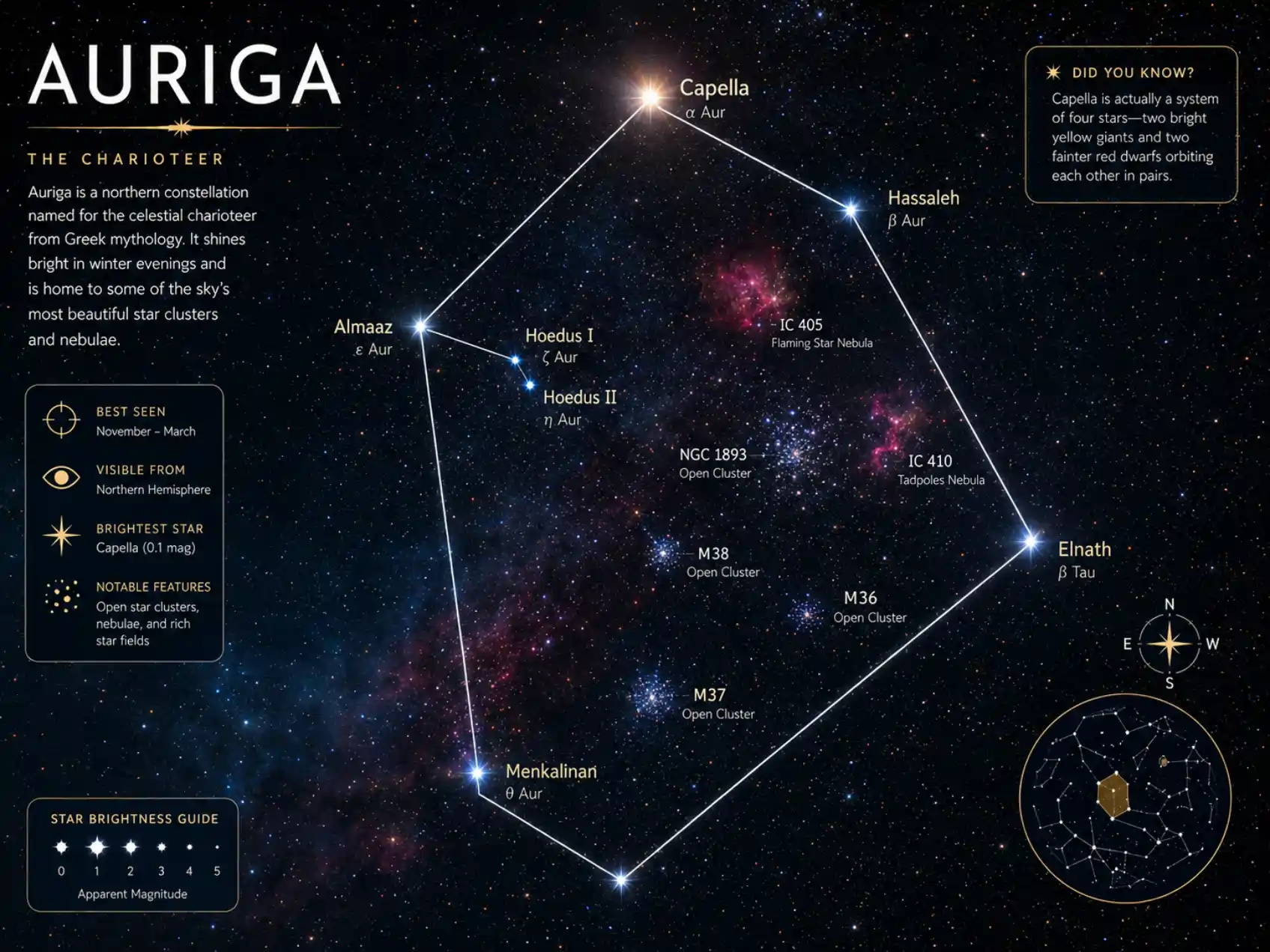
Auriga hosts three famous Messier open clusters — M36, M37, and M38 — which are among the most enjoyable deep-sky targets for casual telescopes and even good binoculars from dark skies.
Auriga Mythology: Who is “The Charioteer”?
In Greek mythology Auriga is often linked to Erichthonius, sometimes described as a king of Athens. In some versions of the myth, he is connected to Hephaestus and is even referred to as the son of Hephaestus (or born through Hephaestus’ involvement). The constellation’s identity as The Charioteer is tied to the invention or mastery of the horse chariot (the four-horse quadriga), which is why Auriga is traditionally depicted holding the reins.
You’ll sometimes see Auriga depicted holding a chariot’s reins, and in older star atlases he may also appear with a goat and kids (a “goat-carrier” motif that overlaps with Capella’s name and myth associations). The key takeaway for stargazing is simple: Auriga = The Charioteer constellation — and the bright “goat star” you’ll use to locate it is Capella.
When Can You See Auriga from Tenerife?
Auriga is strongly associated with winter evening skies in the Northern Hemisphere. It’s particularly prominent around January–March, when it rides high during evening hours. Many sky guides specifically highlight Auriga as a constellation that is easy to spot in February thanks to Capella.
Best time of night
- Early evening (after astronomical twilight): Auriga is already up and bright.
- Mid-evening: often the easiest time for guided groups (comfortable, high altitude in the sky).
- Late night: it remains visible for hours, slowly shifting westward.
In Teide National Park, the exact “best” moment depends on season, moonlight, and your tour timing — but in winter, Auriga is a very reliable constellation to include in a session.
How to Find the Auriga Constellation Step-by-Step
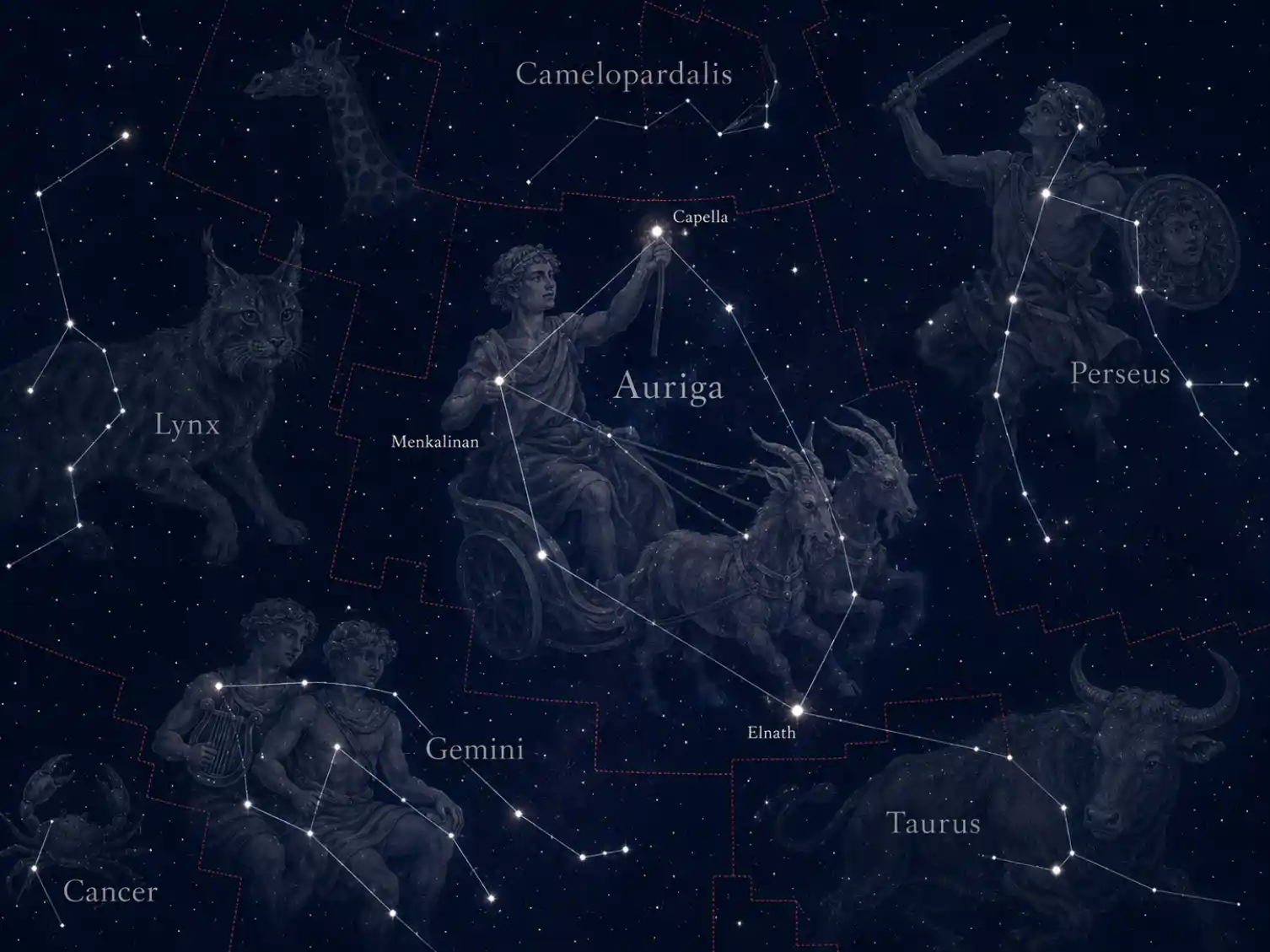
Once you’ve identified the main outline, you’ll notice there are many other stars you can explore — each star in the constellation has its own story and designation (for example AE Aurigae, a famous variable/runaway star associated with the region). In many classic illustrations of the Charioteer, Capella is placed high in the figure, while other stars mark areas like the charioteer’s left shoulder.
Step 1 — Find Capella
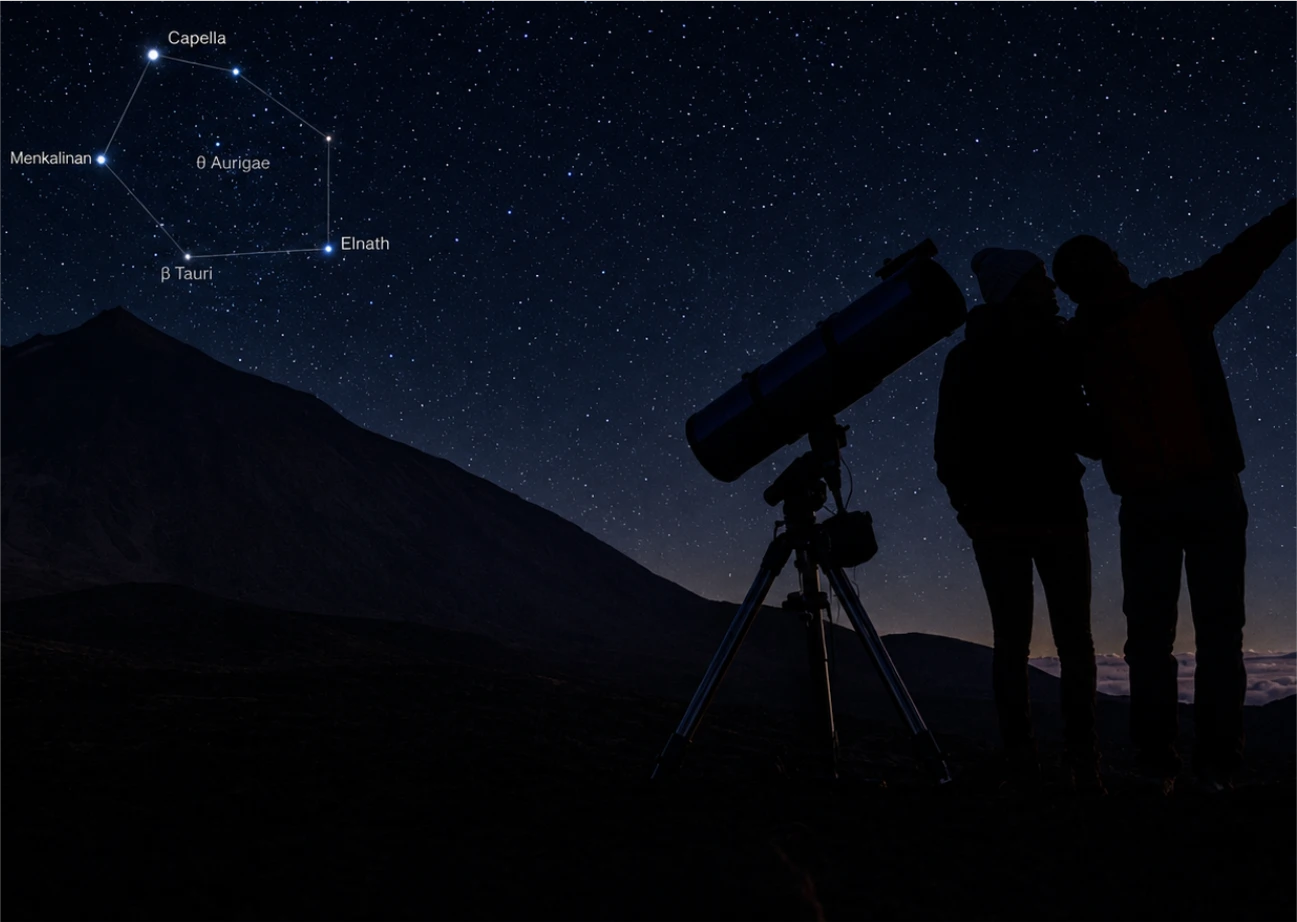
Start by looking for a bright, steady star that doesn’t “twinkle wildly” compared to lower-altitude stars. That bright point is Capella, the star you can treat as the “top light” of Auriga.
Step 2 — Identify Auriga’s “pentagon” outline
Once you have Capella, look for a loose polygon/pentagon shape of stars surrounding it. Many guides describe Auriga as a “pentagon” or “crooked house” shape with Capella as the most obvious corner.
Step 3 — Confirm with neighbouring constellations
A useful nearby reference is star Elnath (Beta Tauri), which sits close to the Auriga–Taurus border and can help you confirm you’re looking in the right winter sky region.
To be sure you’re in the right place:
- Taurus lies nearby (look for its bright star Aldebaran and the Pleiades cluster).
- Gemini is close as well (with its twin bright stars, Castor and Pollux).
From Tenerife’s dark sky, these “signposts” are often very clear on good nights.
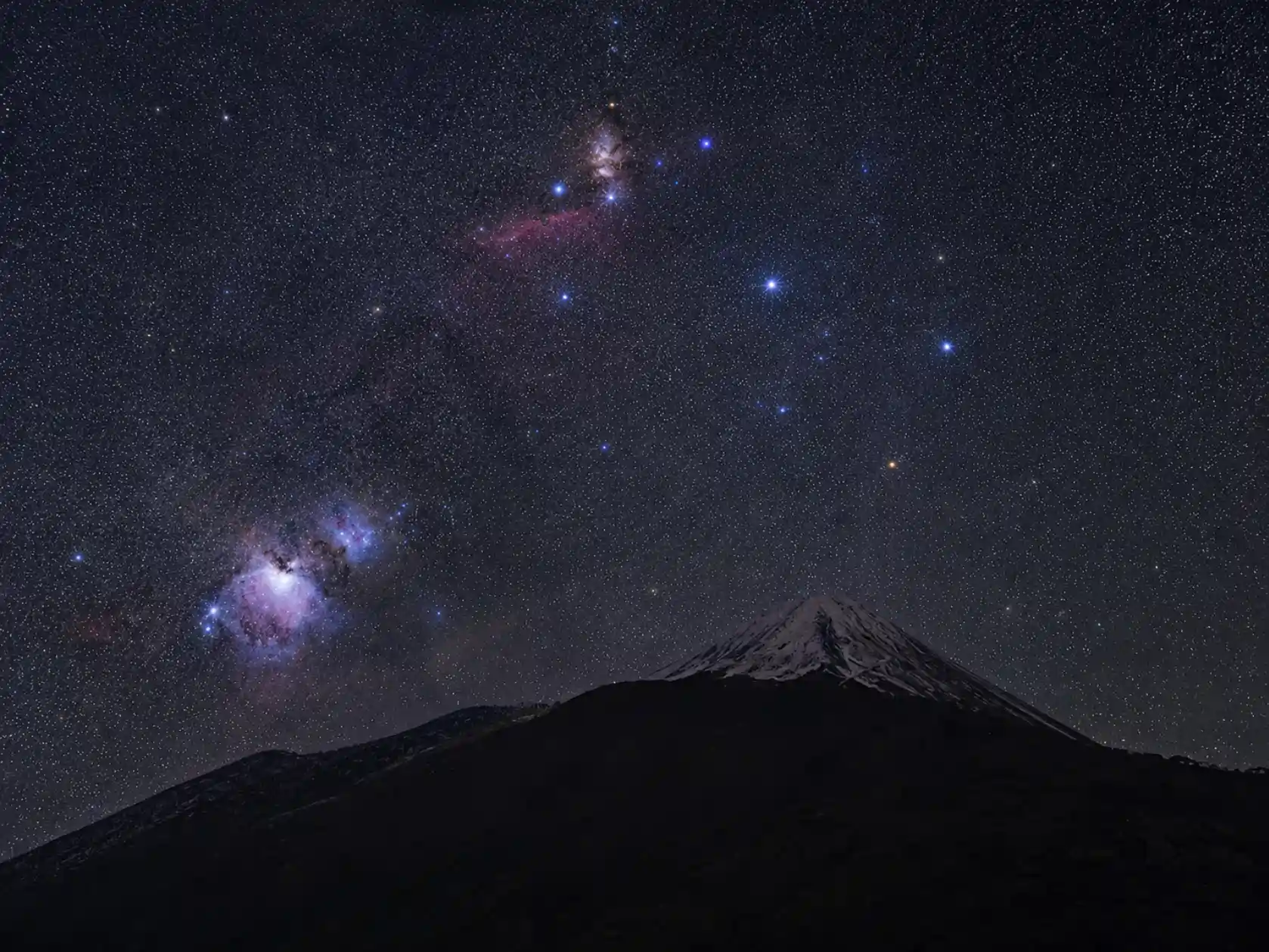
The Brightest Star in Auriga: Capella (Alpha Aurigae)
Capella the brightest star in Auriga is sometimes nicknamed the goat star, reflecting older “goat-carrier” imagery in classical star lore. Capella is roughly 43 light years from us — in other words, 43 light years away from Earth — which helps put its brilliance into perspective. In modern usage, constellation boundaries are defined by the International Astronomical Union, but for stargazers Capella remains the practical “anchor” you use to recognise Auriga instantly. Astronomically, Capella is a well-known bright system featuring evolved stars often described in popular guides as giant star components.
A quick “stargazer’s profile” of Capella
- Brightness: about magnitude 0.08
- Sky role: a key winter landmark; in the UK it’s prominent and often circumpolar in many areas
- Colour impression: many people describe it as yellow-white
You don’t need to memorise the astrophysics to enjoy it. The stargazing value is that Capella is an easy anchor point for the entire winter sky tour.
What to See in Auriga (Beyond the Stars)
If you’re using binoculars or a telescope under a dark night sky in Teide National Park, Auriga also points you towards fascinating nebula targets like IC 405 (the Flaming Star Nebula) and IC 410 (home to the “Tadpoles”). These are more challenging than the open clusters and often depend on sky darkness, transparency, and equipment — but they’re excellent “next level” objects once you’ve enjoyed M36, M37, and M38.
The Auriga Messier Clusters: M36, M37 and M38
These three open clusters are often introduced together because they sit in the same constellation and are all accessible with small telescopes from dark sites.
M36 (The Pinwheel Cluster)
A compact open cluster that can look like a “spray” of bright points in a small telescope. It’s a satisfying object to show guests because it clearly looks like a cluster rather than a single star.
M37 (Often considered the showpiece)
Many observers describe M37 as the most impressive of the three clusters in Auriga.
On a good night, it can look richer and more populated than you expect — a real “wow” moment when someone first sees it through a telescope.
M38
A looser cluster that some people find easier to recognise as a pattern — almost like a scattered “X” or cross-like shape under certain conditions.
Practical note: the exact appearance of these clusters depends on telescope aperture, magnification, and sky conditions. On moonlit nights you may see fewer cluster stars; under dark conditions in Teide National Park, they can be excellent.
Auriga from Teide — What the Experience Feels Like
A constellation guide shouldn’t just list facts; it should help you imagine the moment.
From Teide National Park, Auriga can look startlingly bright and “present” in the sky. Capella becomes a real lighthouse overhead, and the star fields around it look thick with background stars. If your session includes telescope time, Auriga’s clusters are exactly the kind of targets that turn a “nice view” into an “I didn’t know the sky could look like that” memory.
Astrophotography Tips: Photographing Auriga and Capella in Tenerife
If you bring a camera, Auriga is a great subject because it sits in a region with lots of stars and often a dramatic winter atmosphere.
Simple photo approaches (no heavy jargon)
- Wide-angle Milky Way style shots: Auriga can appear near rich star fields, but the Milky Way core is seasonal; the winter Milky Way is subtler than the summer core.
- Constellation framing: include Capella and the pentagon outline.
- Foreground + sky: volcanic rock silhouettes can add strong composition.
Comfort matters (especially in Teide)
Even in Tenerife, Teide altitude can feel cold at night. If you’re planning to stand still for photos, bring layers.
Quick FAQ: Auriga, the Charioteer Constellation
Is Auriga easy for beginners?
Yes. The “constellation of auriga” is one of the easiest to start with because Capella is such an obvious marker.
What is the “Charioteer constellation”?
That’s Auriga — it’s the same thing. “Charioteer constellation” is a common alternative query.
What can I see in Auriga with a telescope?
The headline targets are the open clusters M36, M37, and M38.
Make Auriga Part of Your Teide Night Sky Checklist
If you’re planning a stargazing evening in Tenerife, Auriga is a smart choice because it combines:
- a bright “signpost” star (Capella),
- an easy-to-recognise constellation pattern,
- and deep-sky objects that look genuinely impressive through telescopes.
And if you’re joining a guided stargazing experience in Teide National Park, Auriga is one of those constellations that tends to “land well” with guests — even those who arrive thinking they’re not into astronomy.
Next Step: See Auriga with Expert Guidance in Teide National Park
If you want a stargazing night where you don’t have to guess what you’re looking at, a guided tour makes the difference: you’ll spend less time searching and more time actually seeing. During a typical Teide session, your guide can point out the constellation patterns and then take you straight to telescope targets like Auriga’s clusters when conditions allow.