Mercury is one of the most fascinating planets to observe from Earth and also one of the most elusive.
Unlike Venus or Jupiter, Mercury rarely dominates the night sky. It stays close to the Sun, appears low near the horizon, and is usually visible only for a short window after sunset or before sunrise. That is exactly what makes seeing it from Tenerife so rewarding.
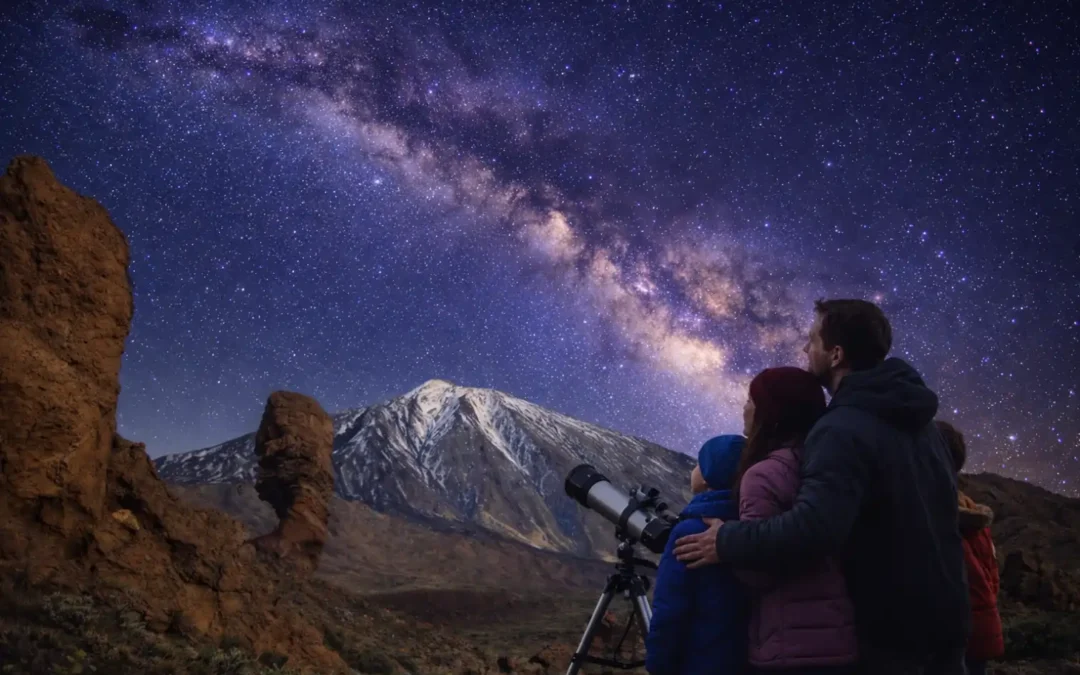
From the open volcanic landscapes of Las Cañadas del Teide, where the horizon feels wider and the sky darker than on the coast, Mercury can become a memorable part of a guided stargazing experience when conditions are right.
In this guide, we explain what Mercury is, why it is so difficult to spot, the best time of year to see Mercury from Tenerife, and how Teide by Night can help visitors understand this small but extraordinary planet.
What Is Mercury?
Mercury is the closest planet to the Sun and the smallest planet in the Solar System. It is only slightly larger than Earth’s Moon, but it moves faster than any other planet, completing one orbit around the Sun in just 88 Earth days.
For anyone searching for information about Mercury, the most important thing to understand is its position. Because Mercury orbits so close to the Sun, it never appears far away from solar glare when seen from Earth.
This is why Mercury is not usually visible in the middle of the night. Instead, it appears briefly:
- after sunset in the western sky, or
- before sunrise in the eastern sky.
From Tenerife, this makes Mercury a planet of timing. You need a clear horizon, good atmospheric conditions and the right season.
Can You See Mercury from Tenerife?
Yes, Mercury can be seen from Tenerife when it is well positioned in the sky.
However, it is more challenging than seeing Venus or Jupiter. Mercury is often low above the horizon and visible for a shorter period. That means visitors need to look at the correct time and in the correct direction.
From Las Cañadas del Teide, Mercury can be easier to appreciate than from many coastal locations because the area offers:
- high-altitude observation points;
- wide volcanic horizons;
- reduced light pollution compared with urban areas;
- clearer skies on many nights;
- expert guidance during a structured stargazing experience.
When Mercury appears after sunset, it is normally seen low in the western sky. It may look like a small, bright point of light, but unlike a star, it does not produce its own light. Mercury shines because it reflects sunlight.
Best Time to See Mercury from Tenerife
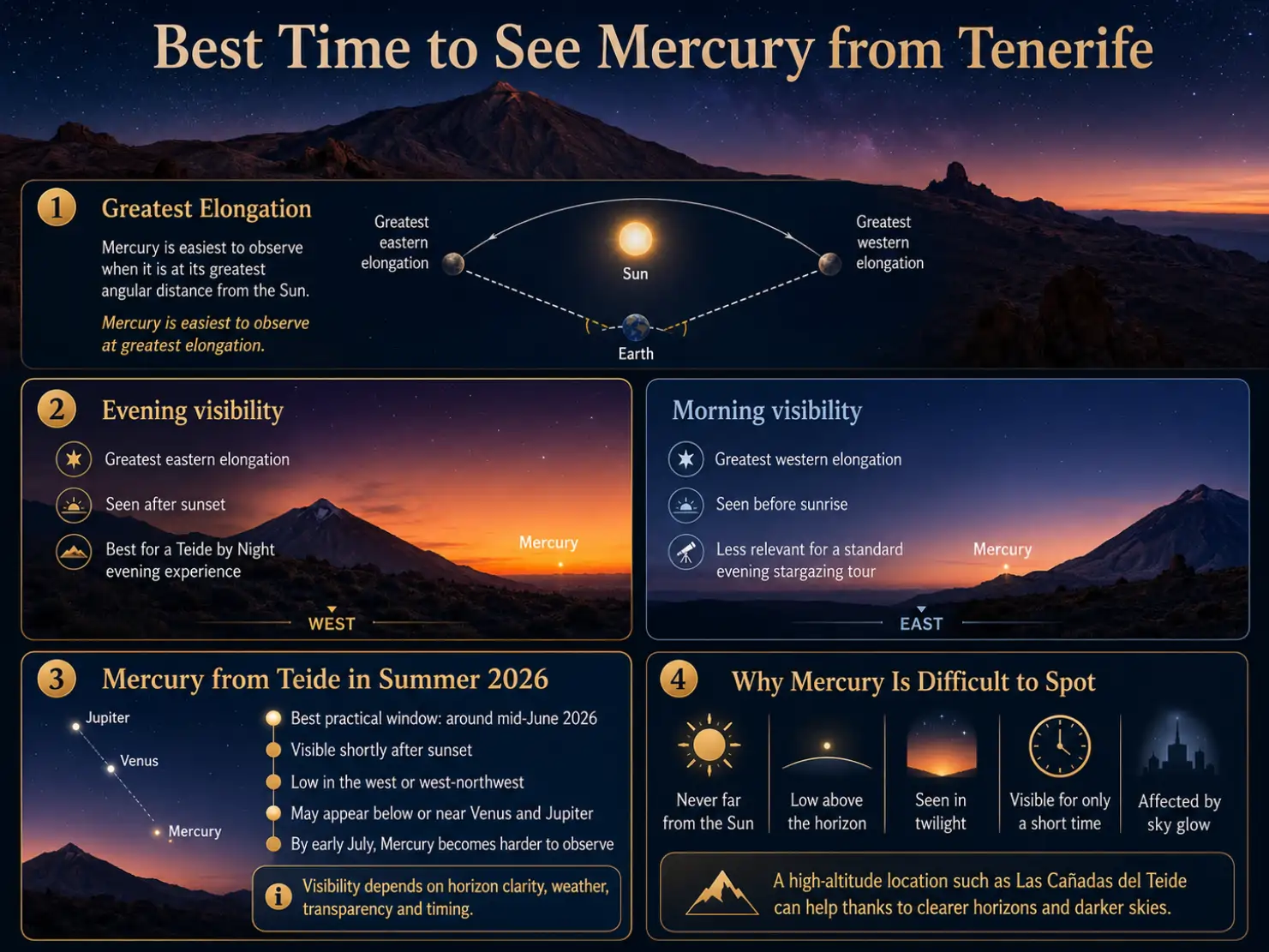
The best time to see Mercury from Tenerife depends on its position relative to the Sun.
Mercury is easiest to observe during what astronomers call greatest elongation. This is when Mercury appears at its greatest angular distance from the Sun in our sky.
There are two useful types:
Evening visibility
When Mercury reaches greatest eastern elongation, it can be seen after sunset in the western sky.
This is the best type of Mercury visibility for a Teide by Night evening experience.
Morning visibility
When Mercury reaches greatest western elongation, it can be seen before sunrise in the eastern sky.
This can be good for early risers, but it is less relevant for a standard evening stargazing tour.
Mercury from Teide in Summer 2026
Summer 2026 is especially interesting because Mercury becomes part of the evening planetary display during June.
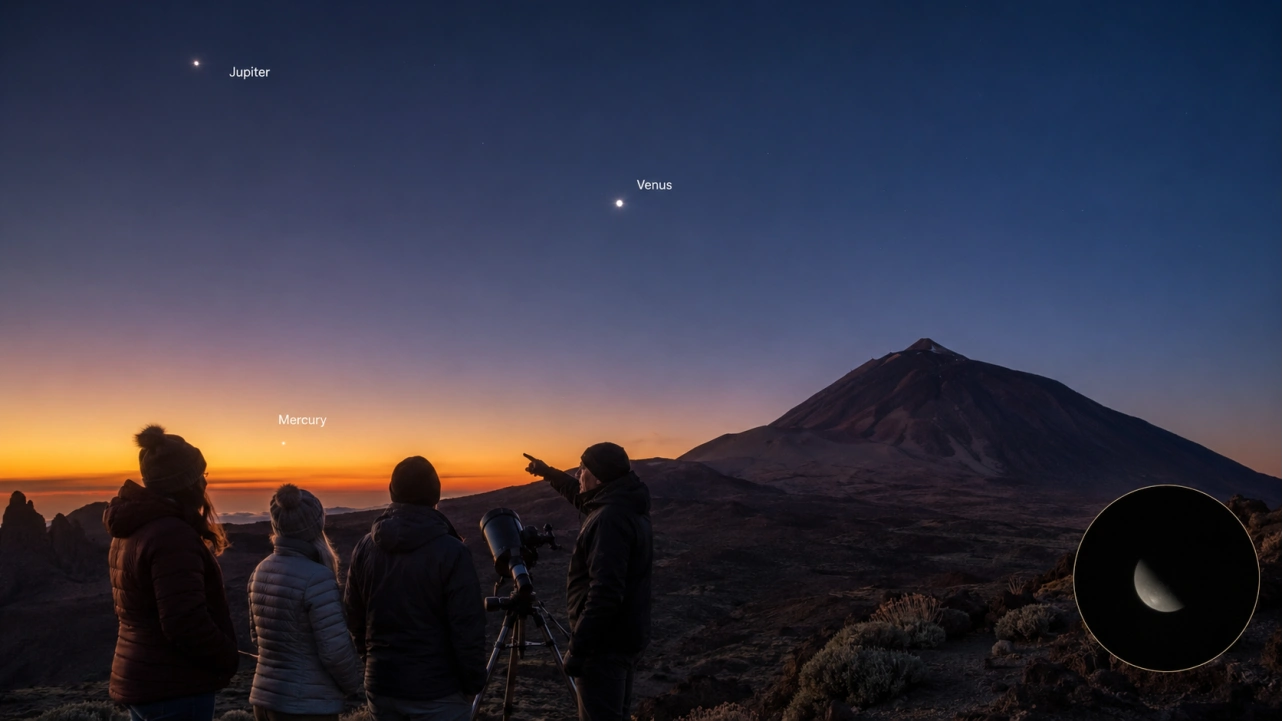
In June 2026, Mercury reaches a favourable evening position and can be searched for shortly after sunset. It appears low in the west or west-northwest, below or near brighter planets such as Venus and Jupiter depending on the exact date.
For guests joining Teide by Night, this means Mercury may be visible during the early part of the evening, especially around mid-June, if the horizon is clear and weather conditions cooperate.
By early July, Mercury becomes harder to observe as it moves closer to the Sun’s glare again.
Best practical window in 2026
For an evening observation from Tenerife, the best practical window is around mid-June 2026, shortly after sunset.
This does not mean Mercury will be visible every night. Its visibility depends on:
- exact date;
- horizon clarity;
- cloud conditions;
- atmospheric transparency;
- timing of the tour;
- whether the planet is too close to the Sun’s glare.
Mercury rewards patience. It is not always obvious, but when you see it, you are looking at one of the most difficult naked-eye planets to catch.
Why Mercury Is Difficult to Spot
Mercury is difficult to observe because it never moves far from the Sun from our perspective on Earth.
Even when it is visible, it usually appears:
- low above the horizon;
- in twilight rather than full darkness;
- for a short period of time;
- close to brighter sky glow after sunset or before sunrise.
This is why a high-altitude location such as Las Cañadas del Teide can make a difference. A clearer horizon and darker environment help visitors identify faint or low objects more easily.
Mercury Planet Information: Key Facts
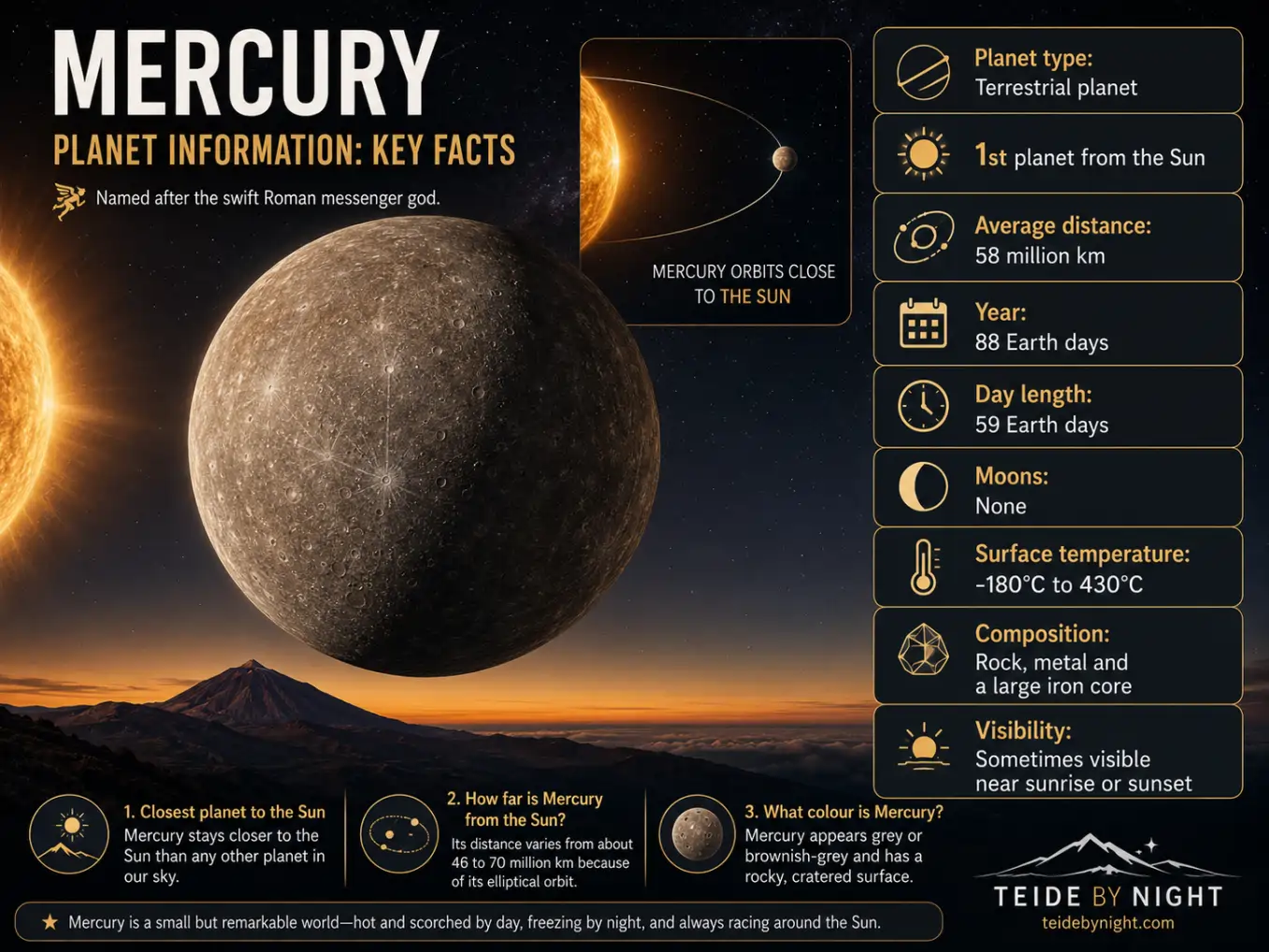
Here are some essential facts about the Mercury planet:
- Planet type: terrestrial planet
- Position from the Sun: first planet
- Average distance from the Sun: about 58 million km
- Orbit around the Sun: 88 Earth days
- Day length: about 59 Earth days
- Moons: none
- Surface temperature: from around -180°C to 430°C
- Main composition: rock and metal, with a large iron core
- Visibility: sometimes visible to the naked eye near sunrise or sunset
Mercury is small, fast, rocky and extreme. It is a planet of contrasts: close to the Sun, yet not the hottest planet; visible from Earth, yet often hard to find.
Mercury Is the Closest Planet to the Sun
Mercury is known as the closest planet to the Sun.
Its average distance from the Sun is about 58 million kilometres, but its orbit is not perfectly circular. It travels around the Sun in an elongated orbit, meaning its actual distance changes throughout its year.
This close relationship with the Sun explains why Mercury is always seen near twilight from Earth. It never appears high in the midnight sky like Jupiter, Saturn or Mars can.
How Far Is Mercury from the Sun?
The average distance Mercury from Sun is about 58 million km.
However, because Mercury has an elliptical orbit, its distance varies. At its closest, it comes to roughly 46 million km from the Sun. At its farthest, it reaches around 70 million km.
This fast, tight orbit is one reason Mercury was associated with speed in ancient mythology.
Mercury Planet Symbolism
Mercury is named after the swift Roman messenger god.
This symbolism fits the planet perfectly. Mercury moves quickly around the Sun and changes position rapidly in our sky. Ancient observers noticed its fast movement near the horizon, long before modern astronomy explained its orbit.
In astrology and mythology, Mercury has often been linked with communication, movement, travel and intelligence. In astronomy, its symbolism is more literal: Mercury is the fast messenger of the Solar System.
What Colour Is Mercury?
Mercury is usually grey or brownish-grey.
Its surface is rocky, dusty and heavily cratered, making it look similar to the Moon. Some spacecraft images show Mercury in enhanced colours, but those images often use scientific processing to reveal differences in minerals and surface composition.
To the naked eye from Tenerife, Mercury does not show a visible disc or colour detail. It appears as a small point of light.
What Is Planet Mercury Made Out Of?
Mercury is a terrestrial planet, which means it has a solid surface.
It is mainly made of silicate rock and metal. One of its most notable features is its large iron-rich core, which makes up a significant part of the planet’s interior.
This gives Mercury a surprisingly high density for such a small world.
Elements on Mercury
When people search for elements on Mercury, they are usually asking what the planet is made of.
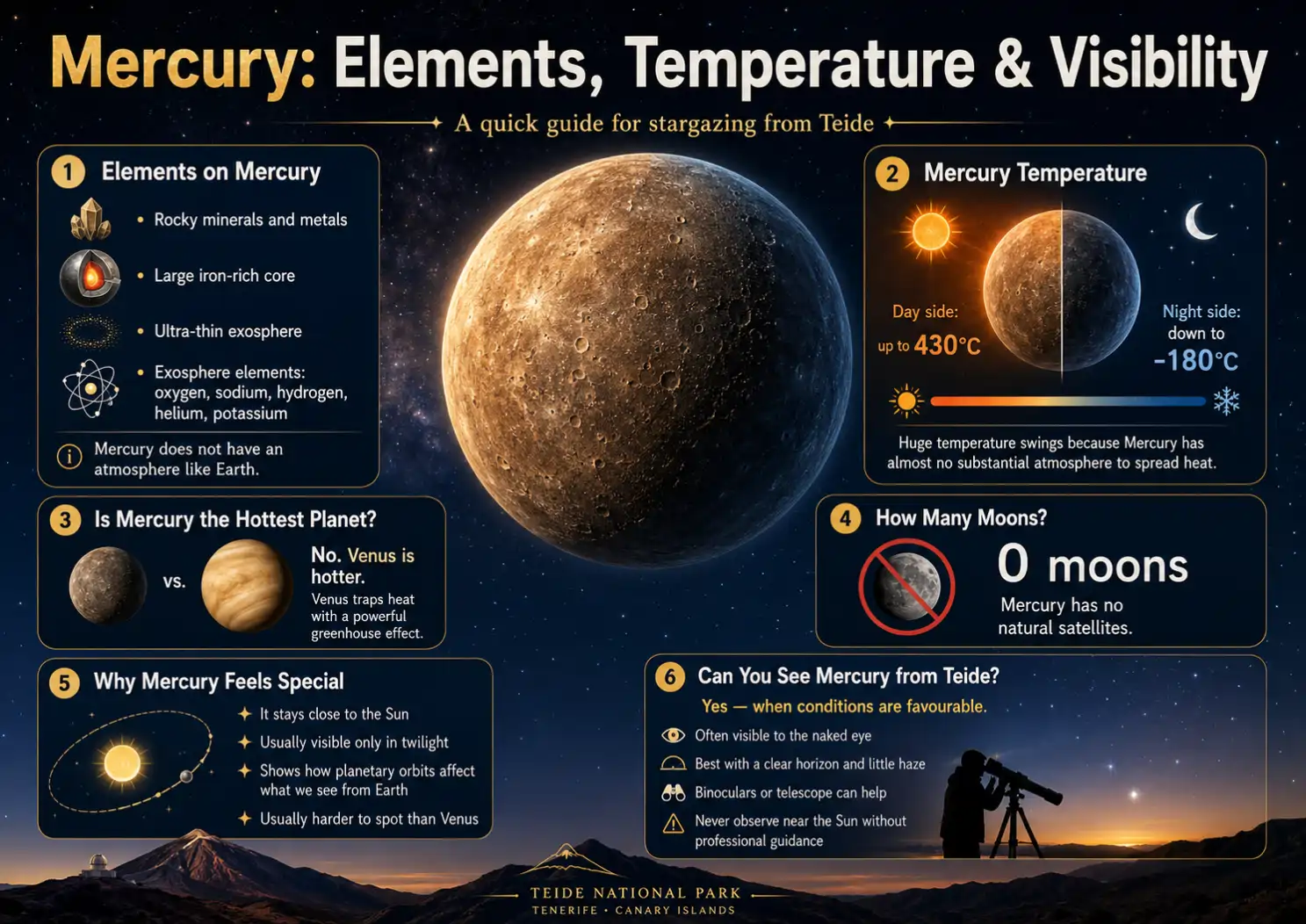
Mercury’s surface and interior include rocky minerals and metals, especially iron. Its extremely thin atmosphere, known as an exosphere, contains elements such as oxygen, sodium, hydrogen, helium and potassium.
However, Mercury does not have an atmosphere like Earth. Its exosphere is very thin and offers little protection from solar radiation or impacts.
Mercury Temperature: How Hot Is Mercury?
Mercury experiences some of the most extreme temperature changes in the Solar System.
On the side facing the Sun, temperatures can reach around 430°C. On the night side, temperatures can fall to around -180°C.
This happens because Mercury has almost no substantial atmosphere to spread heat around the planet. The side facing the Sun becomes intensely hot, while the side in darkness cools dramatically.
So, how hot is Mercury? Very hot during the day — but freezing cold at night.
Is Mercury the Hottest Planet?
No. Mercury is not the hottest planet, even though it is closest to the Sun.
That title belongs to Venus. Venus has a thick atmosphere that traps heat through a powerful greenhouse effect.
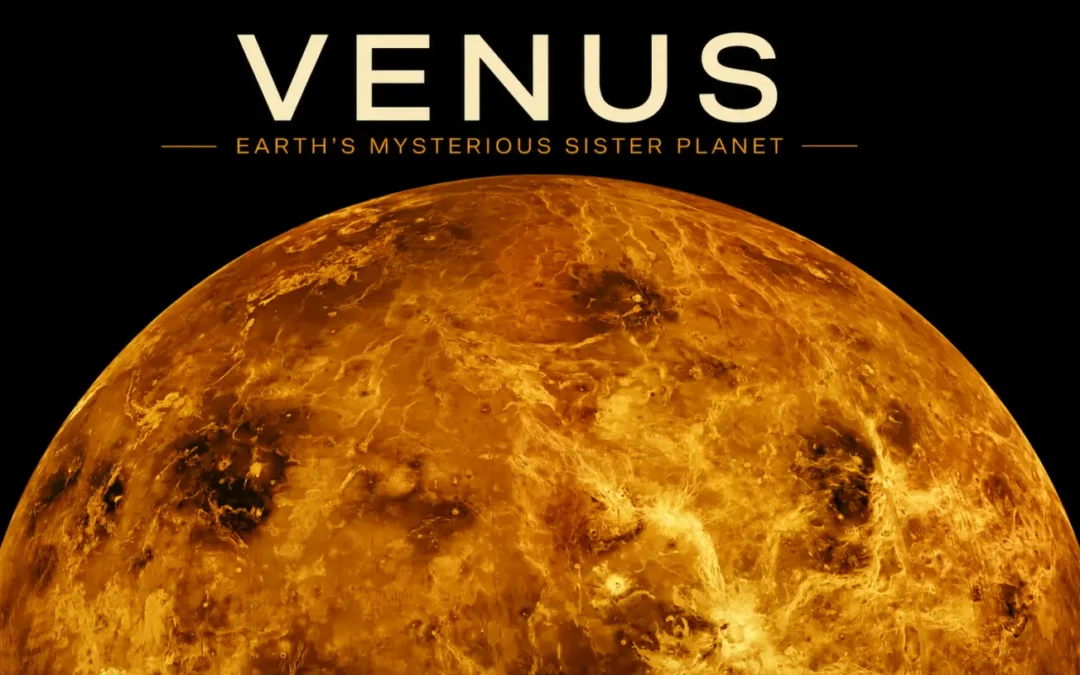
This is a useful comparison for stargazing visitors. If you are interested in planetary extremes, you can also read our article about Venus here:
How Many Moons Does Mercury Have?
Mercury has no moons.
So, if you are wondering how many moons does Mercury have, the answer is simple: zero.
Mercury’s close position to the Sun makes it difficult for the planet to hold natural satellites. The Sun’s powerful gravity would make stable moon orbits around Mercury extremely unlikely.
Mercury Moons: Why Are There None?
The phrase Mercury moons is commonly searched, but Mercury has no natural moons.
This makes Mercury very different from Jupiter, which has many moons, including the famous Galilean moons: Io, Europa, Ganymede and Callisto.
If you want to compare Mercury with a planet that has a rich moon system, read our Jupiter guide here:
Why Mercury Is Special During a Stargazing Tour
Mercury is not the easiest planet to observe, but that is exactly why it feels special.
During a guided stargazing experience, Mercury gives visitors a chance to understand several important astronomical ideas:
- why inner planets stay close to the Sun;
- why some planets are visible only in twilight;
- how planetary orbits affect what we see from Earth;
- why Venus is usually easier to see than Mercury;
- how professional guidance helps identify subtle sky objects.
Seeing Mercury is not just about spotting a planet. It is about understanding how the Solar System works from Earth’s point of view.
Can You See Mercury with the Naked Eye from Teide?
Yes, Mercury can be visible with the naked eye from the Teide area when conditions are favourable.
However, it is not always easy. Mercury can be hidden by:
- twilight glow;
- low clouds;
- haze near the horizon;
- mountains or terrain;
- timing that is too early or too late.
A telescope is not always necessary to identify Mercury, but binoculars or optical guidance may help. Safety is important: never point binoculars or telescopes near the Sun unless supervised by professionals using appropriate solar equipment.
What Can You See Through a Telescope?
Through a telescope, Mercury usually appears as a small disc or phase.
It does not reveal dramatic surface detail to casual observers. Unlike Jupiter, where moons and cloud bands can often be observed, Mercury is more subtle. Its reward is not visual drama, but the knowledge that you are seeing the closest planet to the Sun.
For visitors, this can be powerful: a tiny bright point near the horizon becomes a rocky world racing around the Sun every 88 days.
Why Las Cañadas del Teide Is a Good Place to Look for Mercury
Las Cañadas del Teide is one of the most atmospheric places in Tenerife for planet watching.
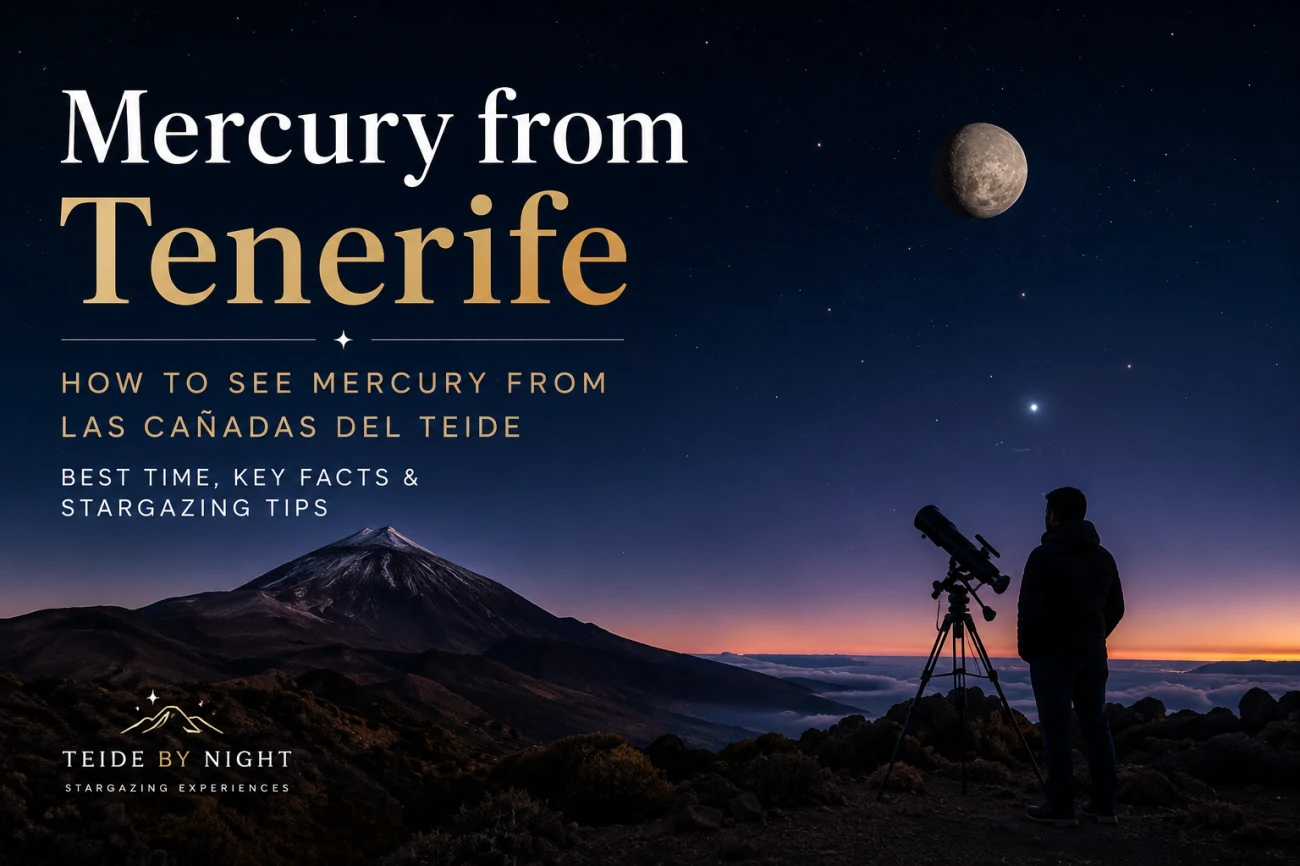
The combination of altitude, volcanic landscapes and open horizons creates a setting where twilight observations can feel especially dramatic. When Mercury appears above the western horizon after sunset, it may be seen against the fading colours of the sky, with the dark volcanic landscape below.
For Mercury, the horizon matters. A low planet needs space. The open views around Teide National Park give visitors a better chance than many urban or coastal areas.
Practical Tips for Observing Mercury from Tenerife
If Mercury is visible during your visit, these tips will help.
Look shortly after sunset
For evening visibility, Mercury is best searched for shortly after sunset in the western sky.
Choose an open western horizon
Mercury stays low. Avoid places where mountains, buildings or trees block the horizon.
Do not wait until late night
Mercury will not stay visible for long. If it is an evening object, it will set soon after the Sun.
Use Venus as a reference when visible
Venus is usually much brighter. If Venus and Mercury are visible in the same period, Venus can help orient your view.
Bring warm clothing
Even in summer, Teide can become cold after sunset. Warm layers are important.
Let your eyes adapt
Avoid bright phone screens and white lights. Twilight objects are easier to notice when your eyes adjust.
Join a guided experience
A guide can help you identify Mercury correctly and distinguish it from stars, aircraft or other bright objects.
Mercury, Venus and Jupiter: A Summer Planet Story
Mercury becomes even more interesting when viewed as part of a wider planetary scene.
In summer 2026, visitors may be able to compare Mercury with Venus and Jupiter during certain evenings.
- Mercury is the elusive inner planet, low near the horizon.
- Venus is the brilliant evening planet, much easier to recognise.
- Jupiter is the giant planet, rewarding through telescopes when visible.
FAQ: Mercury from Tenerife
Can you see Mercury from Tenerife?
Yes. Mercury can be seen from Tenerife when it is well positioned, usually shortly after sunset or before sunrise.
What is the best time to see Mercury from Tenerife?
The best time is around greatest elongation, when Mercury appears farthest from the Sun in our sky. For evening tours, the most useful windows are after sunset.
Can Mercury be seen from Las Cañadas del Teide?
Yes, if conditions are favourable. Las Cañadas del Teide offers open volcanic landscapes, altitude and reduced light pollution, which can help with observing low planets.
Is Mercury a planet?
Yes. Mercury is a planet. It is the closest planet to the Sun and the smallest planet in the Solar System.
What colour is Mercury?
Mercury is mostly grey or brownish-grey, with a cratered rocky surface similar in appearance to the Moon.
How many moons does Mercury have?
Mercury has no moons.
How hot is Mercury?
Mercury can reach around 430°C on its Sun-facing side and fall to around -180°C on its night side.
What is Mercury made out of?
Mercury is mainly made of rock and metal, with a large iron-rich core.
How far is Mercury from the Sun?
Mercury’s average distance from the Sun is about 58 million km, although its orbit varies between roughly 46 and 70 million km.
Is Mercury easy to see from Tenerife?
It can be seen, but it is more challenging than Venus or Jupiter because it stays close to the Sun and appears low near the horizon.
Book a Stargazing Experience in Tenerife
Mercury is small, fast and difficult to catch — but that makes it one of the most satisfying planets to identify from Tenerife.
From Las Cañadas del Teide, a guided experience can help you understand not only where Mercury is, but why it appears where it does, why it moves so quickly and how it fits into the wider story of the Solar System.
Join Teide by Night for a memorable evening under the stars, with volcanic landscapes, expert explanations and telescope observation from one of Tenerife’s most spectacular high-altitude environments.
Book your stargazing experience in Tenerife:
https://www.teidebynight.com/