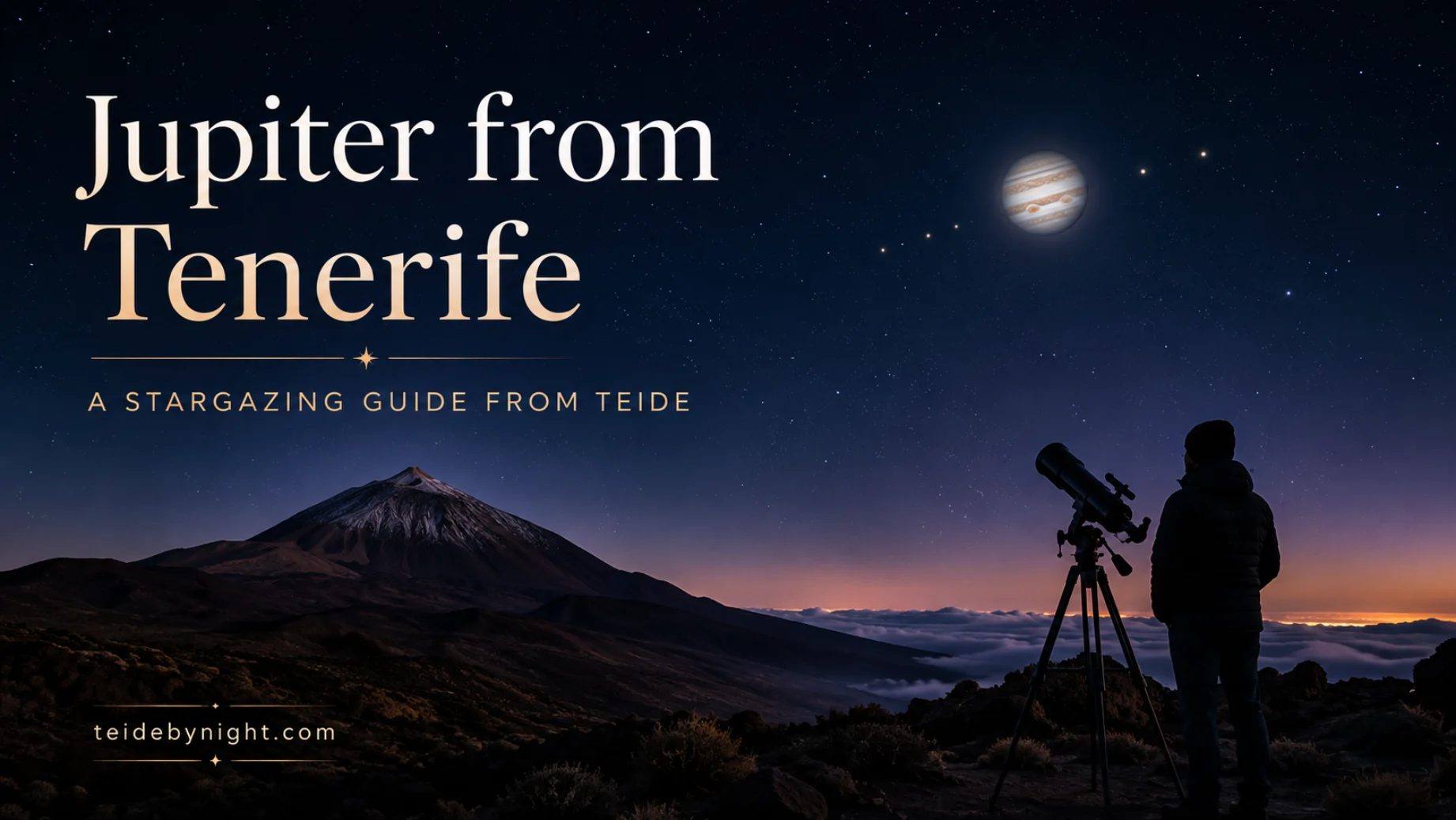
Jupiter is one of the most impressive planets you can observe from Earth. Bright, powerful and surrounded by its famous moons, it is often one of the highlights of a guided stargazing experience in Tenerife.
From the volcanic landscapes of Teide National Park, Jupiter can become much more than a bright point in the sky. With the right conditions, a clear western horizon and expert guidance, visitors can understand why this giant planet has fascinated astronomers for centuries.
In this guide, we explore essential Jupiter planet information, the main characteristics of Jupiter planet, when Jupiter can be seen from Tenerife in summer, and why a Teide by Night stargazing tour is one of the best ways to enjoy it.
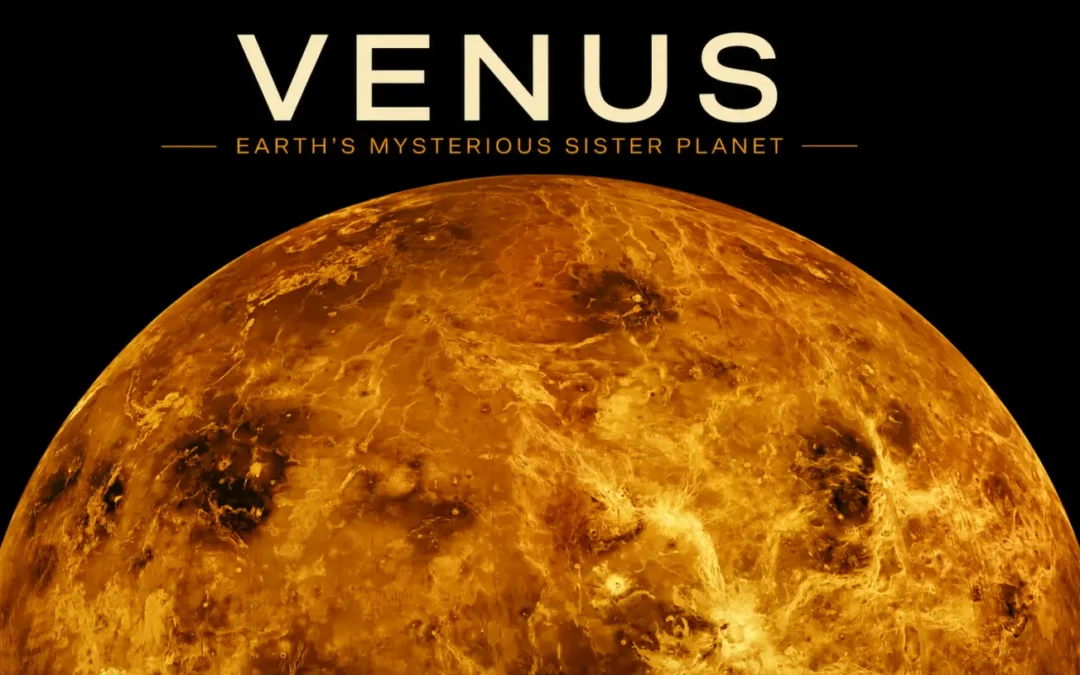
Read our latest article about Venus seen from Las Cañadas del Teide.
What Is Jupiter?
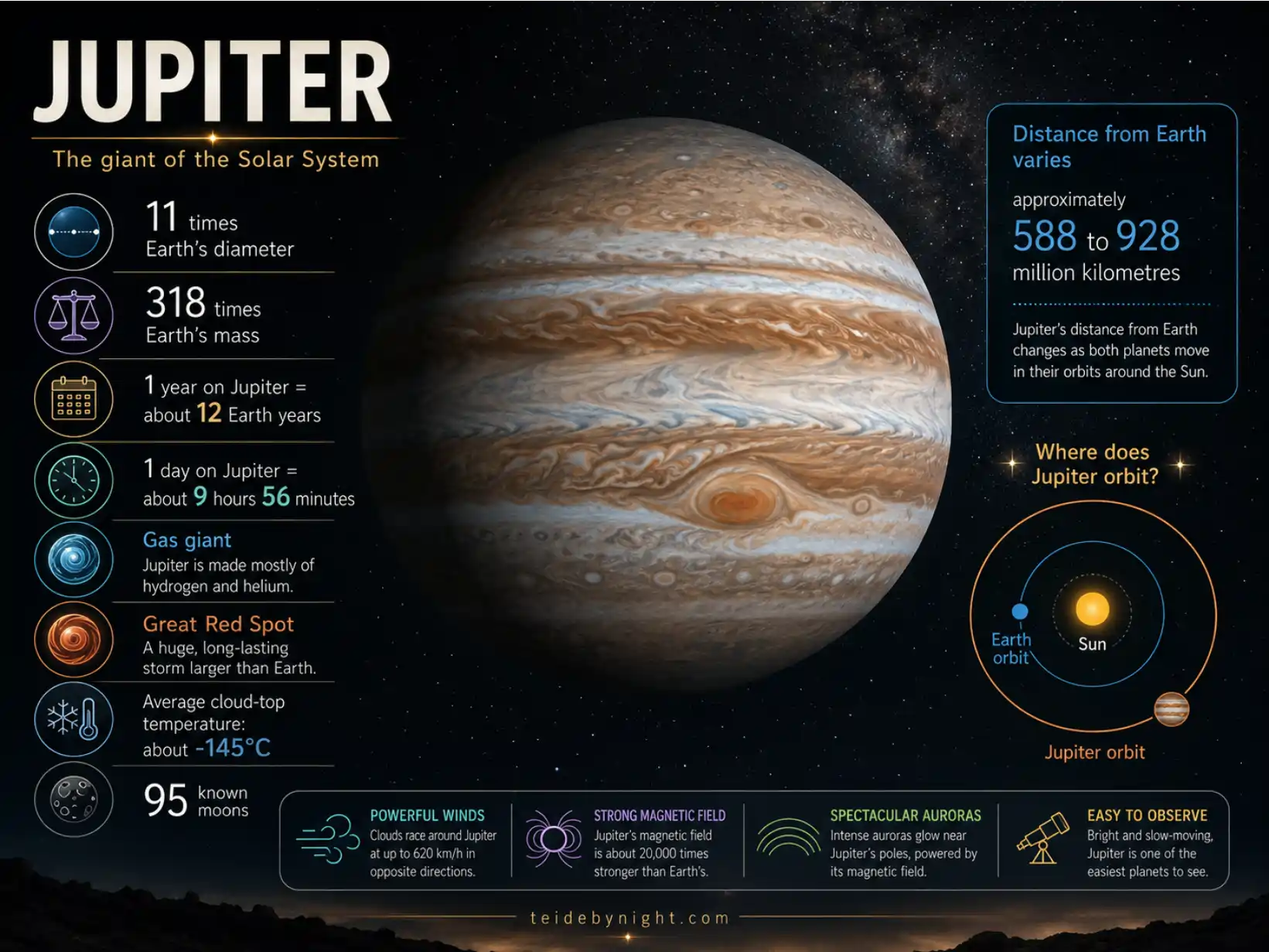
Jupiter is the fifth planet from the Sun and the largest planet in the Solar System. It is a gas giant, mainly made of hydrogen and helium, with no solid surface like Earth, Mars or Venus. The Planetary Society describes Jupiter as a world so massive that it is twice as massive as all the other Solar System objects combined, excluding the Sun.
For anyone searching for information about Jupiter, the first thing to understand is its scale. Jupiter is not just another planet. It is almost like a miniature planetary system, with dozens of moons, powerful storms, a strong magnetic field and a faint ring system.

Jupiter Planet Information: Key Facts
Here is some essential info about Jupiter planet:
- Planet type: Gas giant
- Position from the Sun: Fifth planet
- Diameter: Around 142,984 km
- Atmosphere: Mainly hydrogen and helium
- Length of day: About 10 Earth hours
- Length of year: Around 4,333 Earth days
- Moons: At least 79 known moons
- Most famous moons: Io, Europa, Ganymede and Callisto
- Average distance from the Sun: About 779 million km
Jupiter is 11.2 times wider than Earth, and more than 1,400 Earths could fit inside its volume.
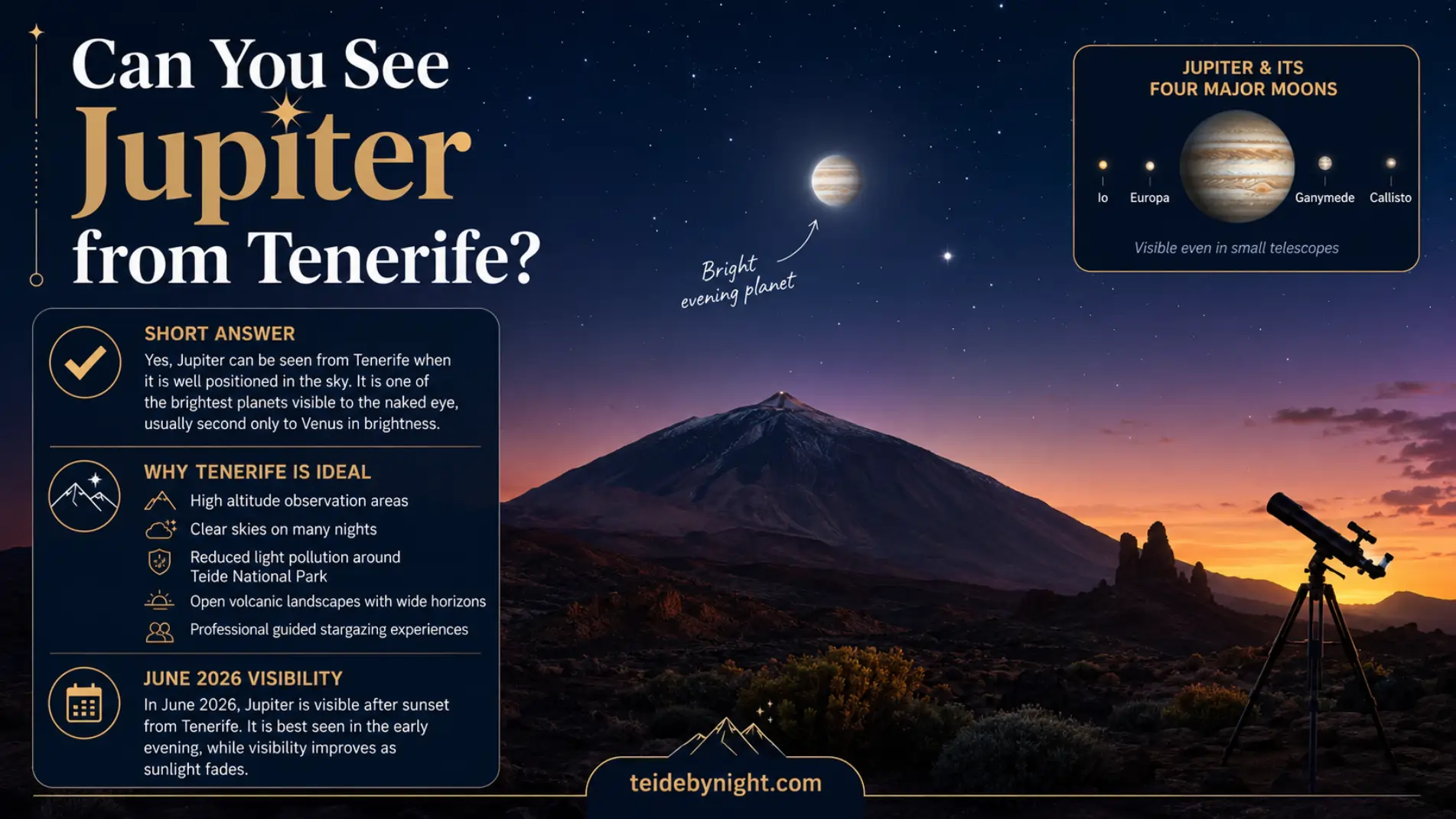
Can You See Jupiter from Tenerife?
Yes, Jupiter can be seen from Tenerife when it is well positioned in the sky. It is one of the brightest planets visible to the naked eye, usually second only to Venus in brightness.
From Tenerife, Jupiter is especially interesting because the island offers excellent conditions for astronomy:
- High altitude observation areas
- Clear skies on many nights
- Reduced light pollution around Teide National Park
- Open volcanic landscapes with wide horizons
- Professional guided stargazing experiences
In June 2026, Jupiter is visible after sunset from Tenerife, although its visibility changes as the planet moves closer to the Sun’s glare later in the season. Timeanddate’s Tenerife visibility data notes that Jupiter is best seen in the hours just after sunset while visibility improves as sunlight fades.
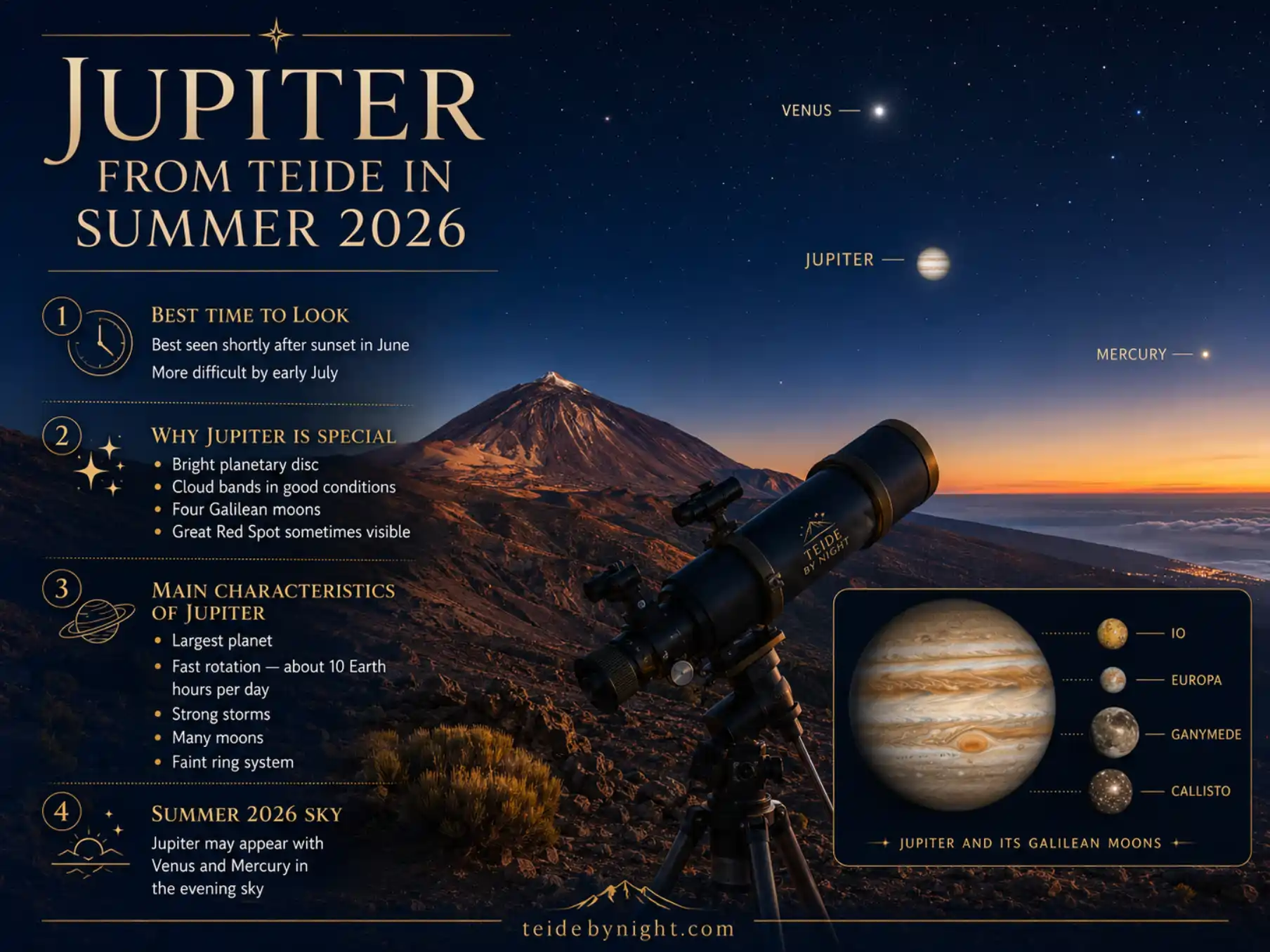
Jupiter from Teide in Summer 2026
Summer 2026 is a particularly interesting season for planet lovers in Tenerife. During June, Jupiter appears in the evening sky and forms part of a wider planetary display with Venus and Mercury. Several sky guides highlight June 2026 as a strong month for planet spotting, including a Venus-Jupiter-Mercury alignment shortly after sunset.
For Teide by Night guests, this means Jupiter may be visible during the early part of the evening, especially in June and early July. However, visibility depends on the exact date, weather, horizon conditions and the timing of the tour.
Best time to look for Jupiter in summer 2026
In summer 2026, Jupiter is mainly an evening object during June. The best moment to look for it is shortly after sunset, before it sinks too low towards the western horizon.
By early July, Jupiter becomes more difficult to observe as it moves deeper into twilight. Astronomy Magazine notes that Jupiter drops into the evening twilight during June 2026, while other sources indicate it becomes increasingly difficult by early July.
Why Jupiter Is Special During a Stargazing Tour
Jupiter is not only bright. It is also one of the most rewarding planets to observe through a telescope.
During a Teide by Night stargazing experience, Jupiter can help visitors understand the difference between simply “looking up” and actually learning the night sky.
Through a telescope, you may see:
- Jupiter’s bright planetary disc
- Its cloud bands, depending on conditions
- The four Galilean moons
- Sometimes the Great Red Spot, if timing and visibility allow
The Galilean moons — Io, Europa, Ganymede and Callisto — are especially important. Galileo Galilei observed them in the early 1600s, helping to prove that not everything in the universe orbits Earth.
The Main Characteristics of Jupiter Planet
Understanding the characteristics of Jupiter planet makes the observation more meaningful.
Jupiter is the largest planet
Jupiter dominates the Solar System. Its mass and gravity have shaped the movement of asteroids, comets and other objects over billions of years.
Jupiter has a fast rotation
A day on Jupiter lasts only about 10 Earth hours. This rapid rotation helps create its flattened shape and powerful atmospheric bands.
Jupiter has strong storms
Jupiter is famous for its storms, especially the Great Red Spot. This enormous storm has been observed for at least 200 years and is larger than Earth.
Jupiter has many moons
Jupiter’s moon system is one of the most fascinating in the Solar System. Its four largest moons are almost worlds of their own.
Jupiter has a faint ring system
Although Saturn is famous for its rings, Jupiter also has a faint ring system. It is not visible to the naked eye, but it adds to the planet’s complexity.
Jupiter’s Four Famous Moons
One of the most exciting parts of observing Jupiter is seeing its moons.
Io
Io is the most volcanically active world in the Solar System. Its surface is constantly changed by volcanic eruptions caused by gravitational forces.
Europa
Europa is one of the most intriguing moons in the search for life. Beneath its icy crust, scientists believe there may be a salty liquid-water ocean.
Ganymede
Ganymede is the largest moon in the Solar System. It is even larger than Mercury and has its own magnetic field.
Callisto
Callisto is heavily cratered and may also have a subsurface ocean, making it another important world for scientific study.
Is Jupiter Visible with the Naked Eye from Teide?
Yes. When Jupiter is above the horizon and not too close to the Sun, it is easily visible to the naked eye from Tenerife.
It usually appears as a very bright, steady point of light. Unlike many stars, planets tend not to twinkle as strongly. From Teide National Park, Jupiter can stand out beautifully against the darker sky once the last light of sunset fades.
However, to appreciate Jupiter properly, a telescope makes a major difference. With guided observation, visitors can understand what they are seeing and may observe the planet’s moons beside it.
What Is Happening to Jupiter in 2026?
In 2026, Jupiter is well placed earlier in the year, with its opposition occurring in January. By June, it is still visible in the evening sky, but it gradually becomes more difficult as it approaches the Sun’s glare from our point of view.
For Tenerife visitors in summer 2026, this means:
- June is the most interesting summer month for evening Jupiter observation.
- Jupiter may be visible after sunset, especially early in the season.
- By July, it becomes harder to see in evening twilight.
- Venus becomes the more dominant evening planet for many Teide by Night experiences.
What Are 5 Facts About Jupiter?
Here are five powerful facts about Jupiter adapted for a Tenerife stargazing context:
- Jupiter is the largest planet in the Solar System.
- It is mainly made of hydrogen and helium.
- Its day lasts only about 10 Earth hours.
- Its Great Red Spot is a huge storm larger than Earth.
- Its four largest moons can often be seen through telescopes.
These facts are especially useful during a guided stargazing tour because they turn a bright dot in the sky into a real world with structure, history and scientific importance.
Why Is Jupiter So Special?
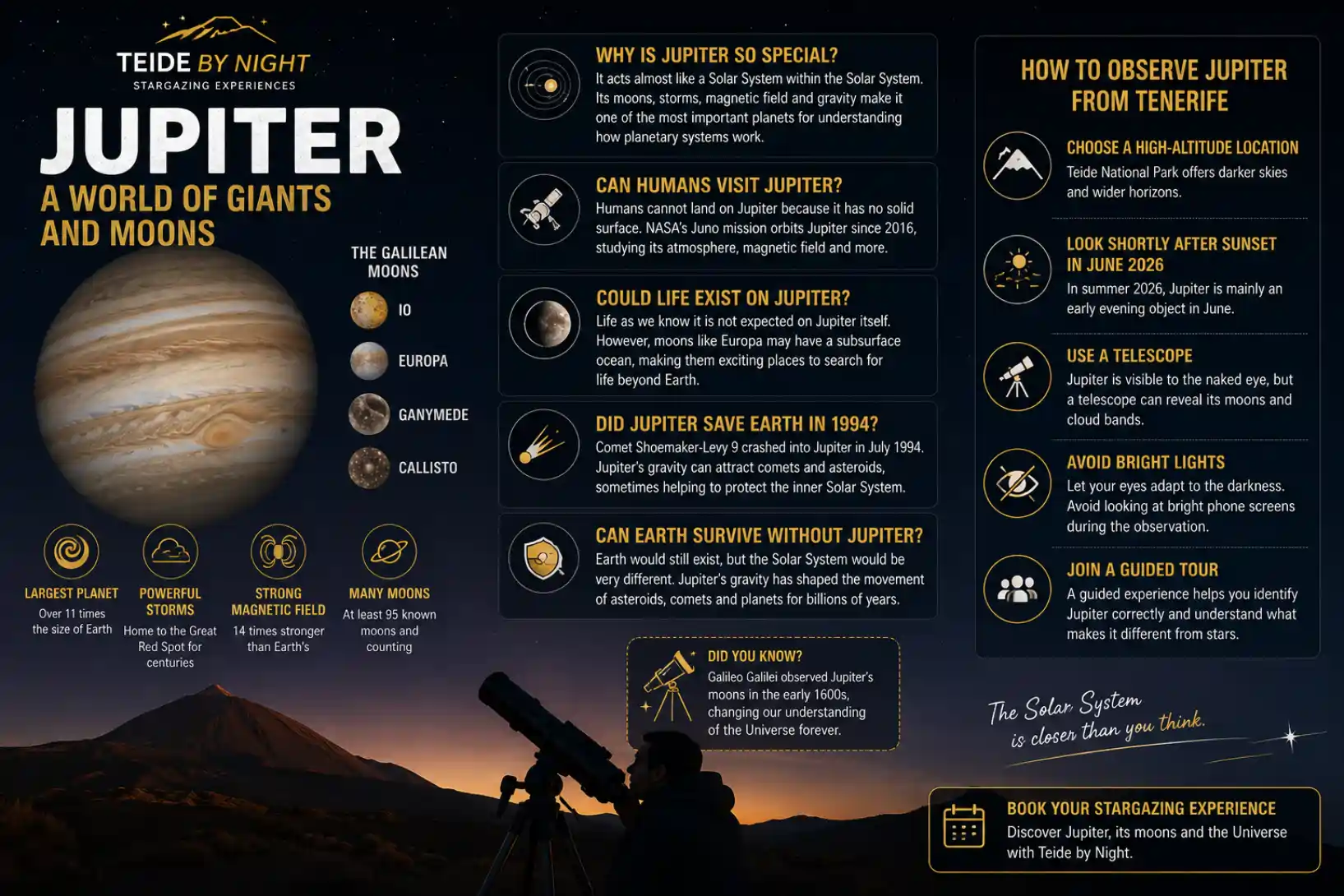
Jupiter is special because it acts almost like a Solar System within the Solar System. Its moons, storms, magnetic field and gravity make it one of the most important planets for understanding how planetary systems work.
The Planetary Society highlights that studying Jupiter helps scientists understand how planetary systems evolve, including systems around other stars.
From a Teide by Night perspective, Jupiter is also special because it is visually accessible. You do not need to be an astronomer to feel its impact. Once you see its moons through a telescope, the Solar System suddenly feels much more real.
Can Humans Visit Jupiter?
Humans cannot land on Jupiter because it has no solid surface. It is a gas giant with an enormous atmosphere and extreme pressure deeper inside.
Spacecraft can fly past Jupiter or orbit it, but they must survive strong radiation and harsh conditions. NASA’s Juno mission entered orbit around Jupiter in 2016 to study its magnetic field, atmosphere and internal structure.
So, while humans cannot walk on Jupiter, we can study it from Earth, from spacecraft and through telescopes — including from high-altitude locations such as Teide National Park.
Could Life Exist on Jupiter?
Life as we know it is not expected on Jupiter itself. Its atmosphere is turbulent, extreme and lacks a solid surface.
However, some of Jupiter’s moons are among the most promising places to search for life beyond Earth. Europa, in particular, may have a subsurface ocean beneath its icy shell, making it a major target for future scientific exploration.
This makes Jupiter fascinating during a stargazing tour: when you look at Jupiter, you are also looking towards a system of moons that may hold clues about life elsewhere in the Solar System.
Did Jupiter Save Earth in 1994?
This question refers to Comet Shoemaker-Levy 9, which crashed into Jupiter in July 1994. The impact was observed by spacecraft and Earth-based telescopes and became one of the most important astronomical events of the decade.
Jupiter’s gravity can influence comets and asteroids, sometimes pulling them in. This has led to the idea that Jupiter may help protect the inner Solar System from some impacts, although the relationship is complex.
From Tenerife, stories like this make Jupiter more than a beautiful planet. They show how dynamic and interconnected the Solar System really is.
Can Earth Survive Without Jupiter?
Earth would still exist without Jupiter, but the Solar System would be very different. Jupiter’s gravity has influenced the movement of asteroids, comets and planets for billions of years.
Scientists study Jupiter partly because its position and mass have shaped the architecture of the Solar System. Without it, the history of impacts, planetary formation and possibly even the delivery of water to early Earth could have been different.
How to Observe Jupiter from Tenerife
If Jupiter is visible during your stay in Tenerife, these tips will help.
Choose a high-altitude location
Teide National Park offers darker skies and wider horizons than many coastal areas.
Look shortly after sunset in June 2026
For summer 2026, Jupiter is mainly an early evening object in June.
Use a telescope
Jupiter is visible to the naked eye, but a telescope can reveal its moons and sometimes cloud bands.
Avoid bright lights
Let your eyes adapt to the darkness. Avoid looking at bright phone screens during the observation.
Join a guided tour
A guided experience helps you identify Jupiter correctly and understand what makes it different from stars.
Why Observe Jupiter with Teide by Night?
Teide by Night is designed to help visitors experience Tenerife’s night sky in a structured, memorable way.
The experience combines:
- Pick-up and transport
- Volcanic landscapes
- Sunset views
- Dinner
- Guided stargazing
- Telescope observation
- Explanations in your selected language
When Jupiter is visible, guides can help you identify it and explain its moons, storms and importance in the Solar System.
Instead of simply asking, “Is that Jupiter?”, you can understand why this giant planet matters.
FAQ: Jupiter from Tenerife
Can I see Jupiter from Tenerife in summer 2026?
Yes, especially in June 2026. Jupiter is visible after sunset but becomes more difficult later in the season as it moves closer to the Sun’s glare.
Is Jupiter visible from Teide with the naked eye?
Yes. Jupiter is one of the brightest planets and can usually be seen without a telescope when conditions are favourable.
Can I see Jupiter’s moons from Tenerife?
With a telescope, yes. Jupiter’s four largest moons can often be seen as small points of light beside the planet.
What is the best month to see Jupiter from Tenerife in summer 2026?
June is the best summer month for evening Jupiter observation. By July, it becomes harder to see in twilight.
Is Jupiter brighter than Venus?
No. Venus is usually brighter than Jupiter. However, Jupiter is still one of the brightest objects in the night sky.
What makes Jupiter different from a star?
Jupiter is a planet. It does not produce its own light like a star. It shines because it reflects sunlight.
Can children enjoy seeing Jupiter on a stargazing tour?
Yes. Jupiter is one of the best planets for children because it is bright, easy to identify and exciting through a telescope.
Book a Stargazing Tour in Tenerife
Jupiter is one of the most fascinating planets to observe from Earth, and seeing it from the volcanic landscapes of Teide National Park makes the experience even more memorable.
Whether you want information of planet Jupiter, practical observing tips or a guided astronomy experience in Tenerife, Teide by Night offers a unique way to connect with the night sky.
Book your stargazing tour in Tenerife with Teide by Night and discover Jupiter, Venus, constellations and the wonders of the summer sky.